| title.alternative | : |
|---|---|
| event date.month | : November |
| event date.lunar month | : waxing 13th – 15th, month 12th |
| location | : : |
| province / region | : Central : Phitsanulok |
| subject | : calendrical rites,festive rites/rites for social auspiciousness |
| relations | : |
| keywords | : Pak Thong Chai, Nakhon Thai, flags, Po Khun Bang Klan Tao, Po Khun Si Inthrathit, Khao Chang Luang |
| creator | : Thirawat Seankham |
| date.issued | : 28 Apr 2017 |
| date.last updated | : 11 Oct 2018 |
Every year the Nakhon Thai District of Phisanulok Province organizes a big fair to celebrate and manifest the admirable unity of its people – the Pak Thong Chai tradition, which is held on waxing 14th of the 12th month. Because it is a tradition that has been sustained through generations, the residents hold a common belief that its origin dated back to the time Po Khun Bang Klang Tao was the ruler of Bang Yang (now Nakhon Thai, so people believe). The benevolent ruler was honored and respected as being the Nakhon Thai hero.
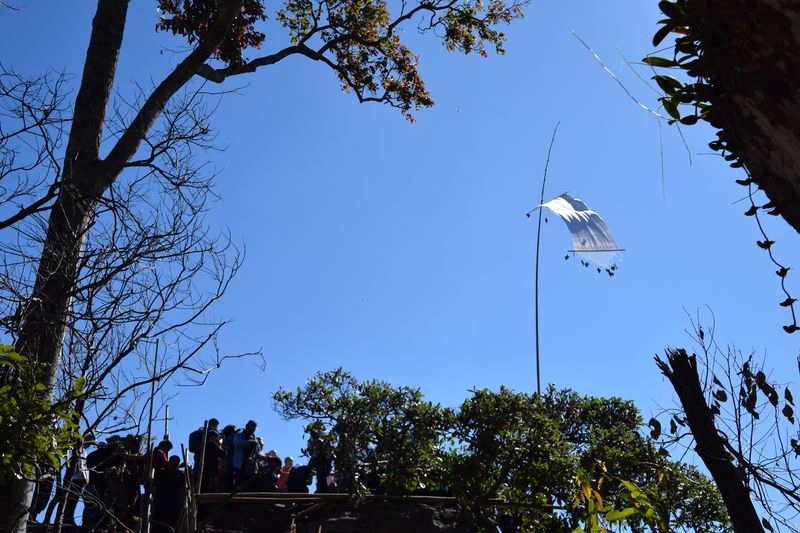
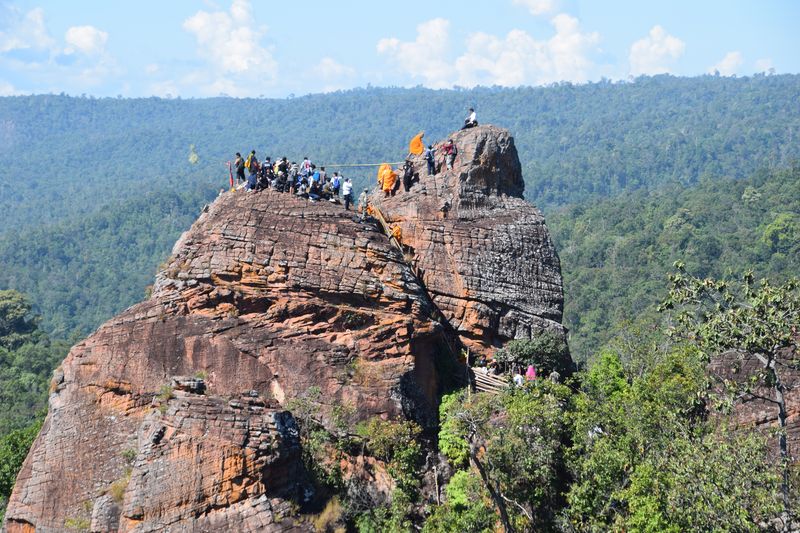
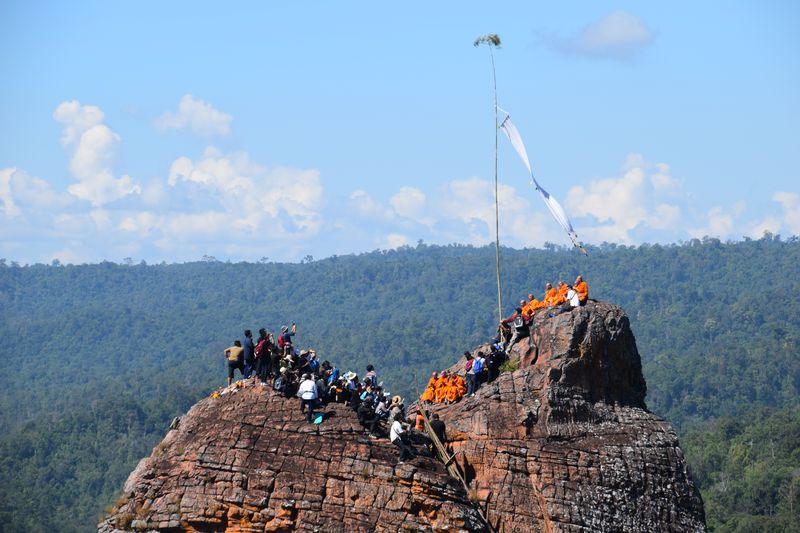
So on the celebration day, local folks will reminisce the time past by hiking up Khao Chang Luang and put some flags on the mountain top. Khao Chang Luang lies parallel to the Nakhon Thai-Chat Trakan Highway, about 9 kilometers to the northeast of the town. This practice is observed every year.
Today, the practice has turned out to be a big event, which apparently has integrated many folk beliefs of the Nakhon Thai community with the history related to the first ruler Po Khun Bang Klang Tao. The Pak Thong Chai tradition, therefore, has come to be invested with some new historical meanings incorporating the notion of nationalism mixed with localism. So now, as a result, Nakhon Thai folks have almost forgotten the true origin of this local tradition.
Bun Pak Thong: the past of the Pak Thong Chai tradition
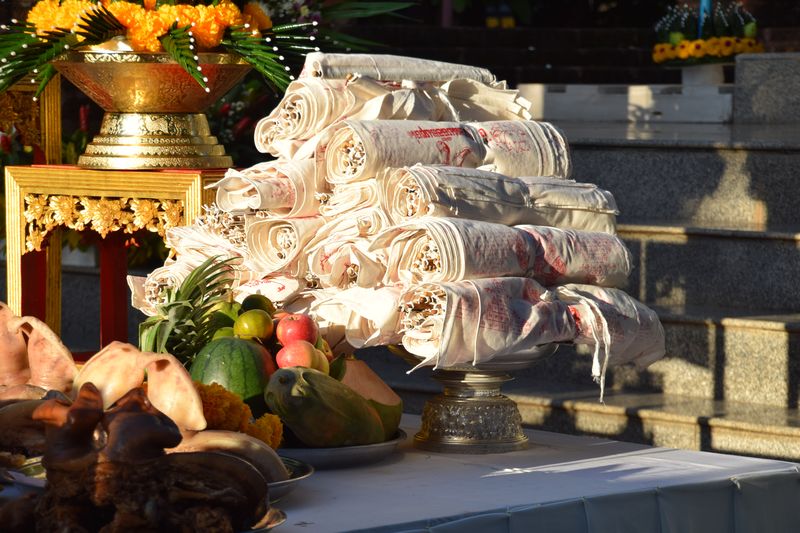
In the past as soon as the 12th month arrived, the Nakhon Thai monks and the community leaders would call a meeting of the villagers in order to decide at whose particular house they would gather to make the special, traditional ritual (white) flags for the merit-making Bun Pak Thong. Normally, it would be the house of someone skillful in weaving. Or it could be the house of the village head. The folks lent their hand doing the weaving job. They brought cotton yarns, made from their own trees, as common materials for the special flags. The weavers generally were the women, as in those days every woman could weave.
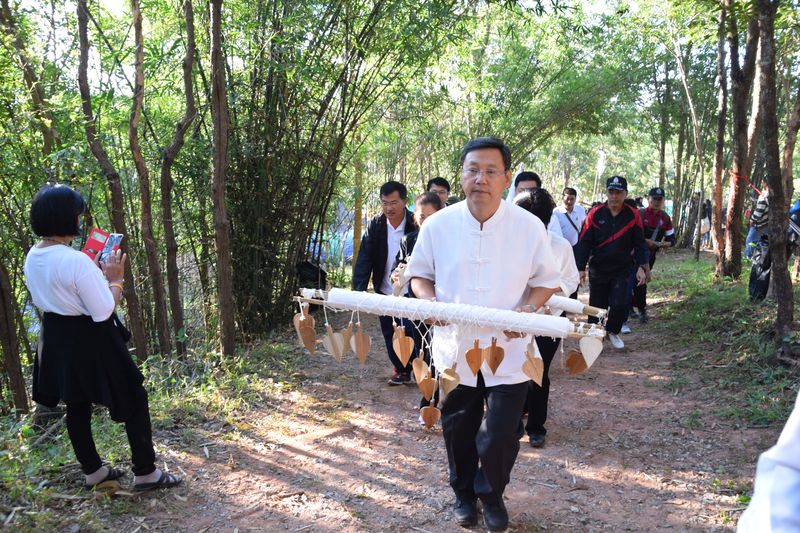
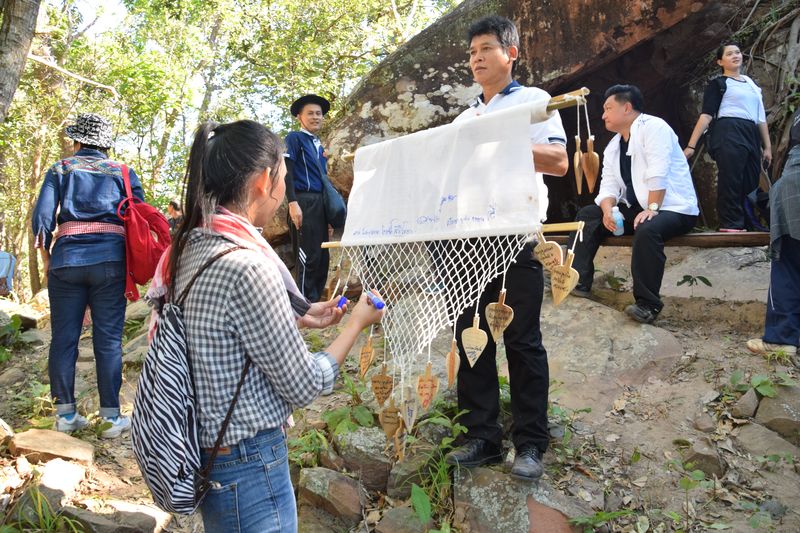
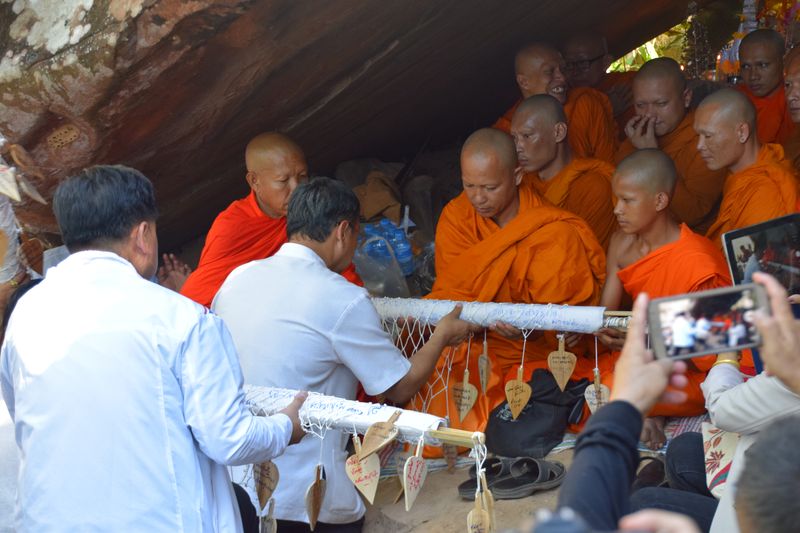
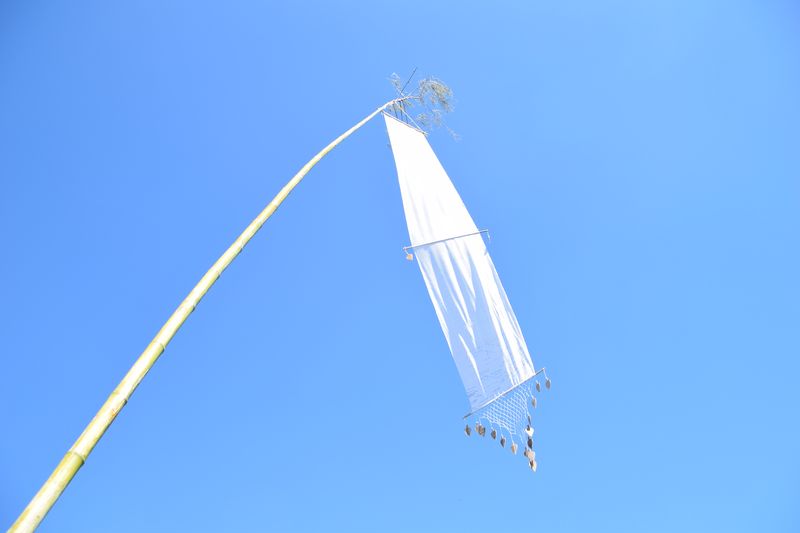
Each of the 3 flags measured 1x a little over 2 meters. Nineteen wooden bhodi leaves were needed for 1 flag. The 3 flags were made by 3 different villages. The wooden bhodi trees were used to decorate the flag edges. Then a 1-foot bamboo tube was tied along one side of the flag to give it some weight support, as it was to be flown on the mountaintop.
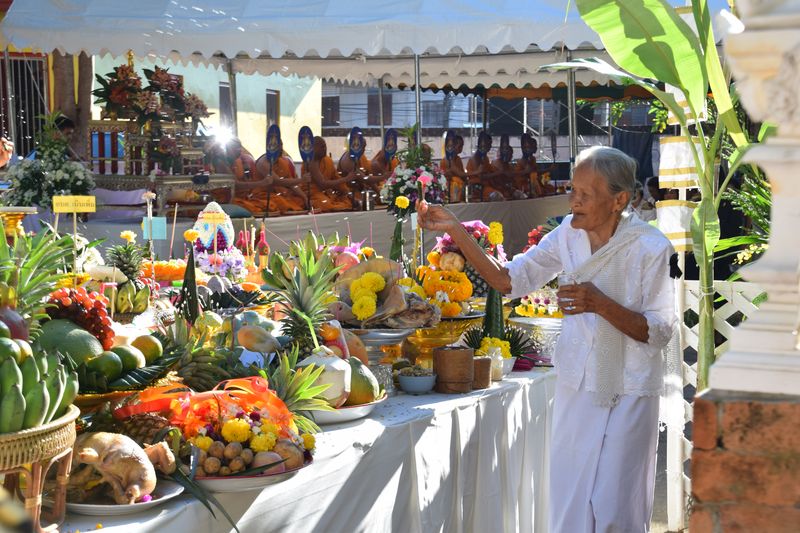
Having the flags thus ready, on waxing 14th of the 12th month villagers gathered at the temple, from where they paraded the flags and headed to the market. Loud music from fiddles, gongs and drums all along the way was heard. The people also danced along – a lively and funfilled time it was. In the evening prior to the flag flying day, there was a religious ceremony, in which monks chanted some evening prayers. The flag celebrations took place at the main temples: Wat Nua (Wat Na Phrathat), Wat Klang, and Wat Hua Rong (Wat Nakhon Thai Wanaram).
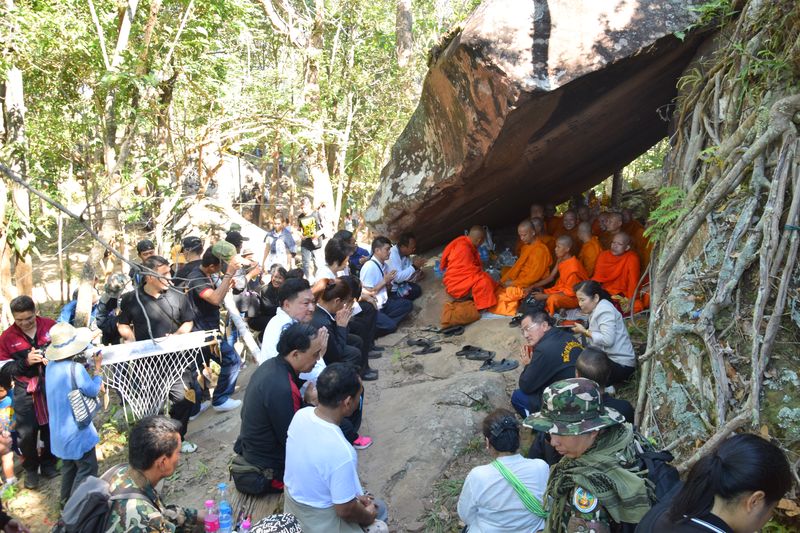
Village folks prepared food for monks early in the morning of the waxing 15th. Some would visit the temple to make merit by offering alms of food. Some would go up the mountain to fly the flags. They packed food for themselves, also for the monks who accompanied them up there. The devotees went up on foot across some rice fields and woods, until they reached the top of Khao Chang Luang.
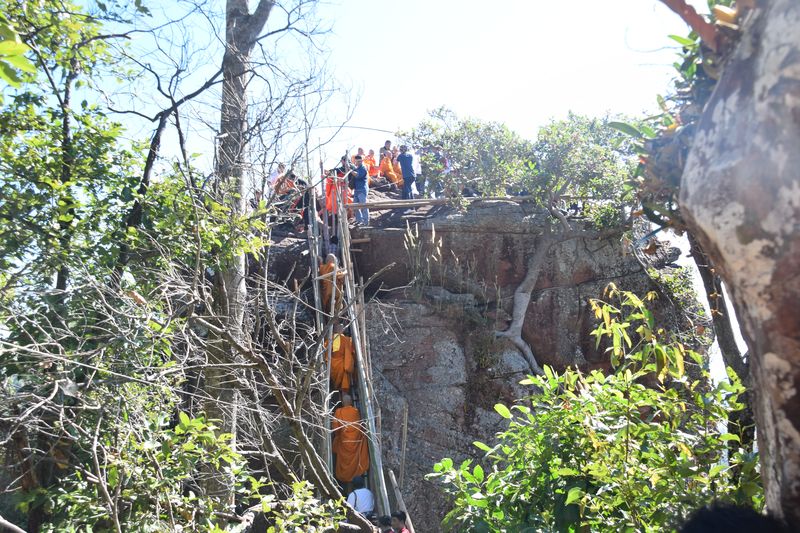
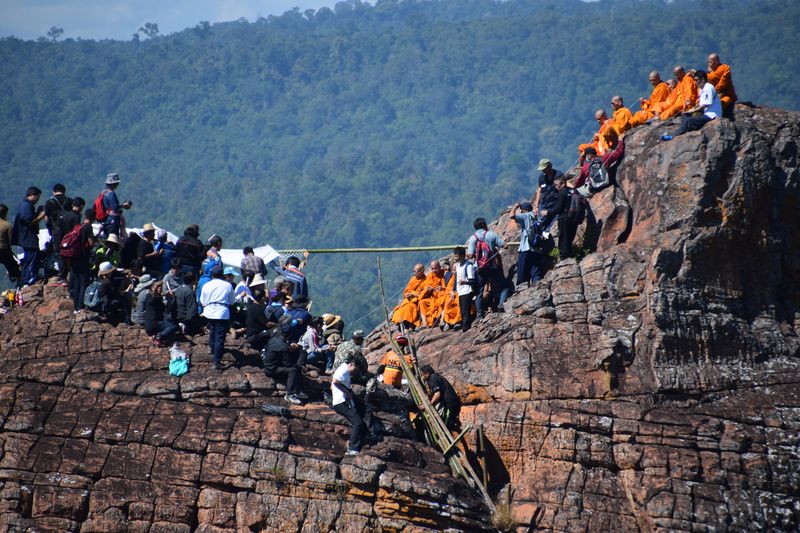
The group had to be there before 11 a.m. so that the monks could have lunch, at Chan Pane Cave. The people ate after the monks. Then the monks and the devotee group carried the flag up a bamboo ladder to the top spot. During this time, the village leader invited the monks to say prayers. The monks chanted blessing prayers. The leader attached the flag to a bamboo post, put the post firmly in the ground, or actually a hole deep enough to secure it. Everybody cheered. A few stones were put in and around the hole to make the post stand erect and withstand strong winds up there. So that was how the ritual ended.
The second flag was to be put up on the top of Khao Yan Hai, 300 meters from Khao Chan Pane. The third flag was to be flown on the top of Khao Chang Luang. The first flag ritual was repeated at the last 2 spots.
Belief in the “Sacred Mountain” – origin of the Pak Thong Chai tradition.
Our interviews with some village folks and studies regarding the tradition based on some printed matter distributed in the area have led to the following conclusions about the origins of this folk belief, or practice, of hoisting flags up on top of the Khao Chang Luang:
First, it was believed that observing the tradition would bring peace, well-being and prosperity. Any year they failed to do it, bad things would befall all in the village – hardship, and even death, caused by a devastating naga, or a man-eater giant, or some wild elephants coming to feed on the rice they grew.
Second, the practice was an expression of respect for Po Khun Bang Klang Tao. In those early days when their ancestors came into the area known as Mueang Nakhon Thai (Mueang Bang Yang), they were forced to wage war with those former occupants of the land. At Khao Chang Luang, Po Khun’s troops were victorious. The happy fighters therefore took Po Khun’s waist piece, tied it to a wood stick and flew the victory flag at the mountaintop. In later years, the ruler continued to have his offsprings or relatives go up to post the flag at the spot he had won the battle – to celebrate and commemorate the victory. He also imposed a curse that any year the practice was not upheld, some unfortunate things would happen to the villagers as a result.
Third, the Nakhon Thai leaders improvised an effective way of communication. In those days, because of the Haw Chinese’s occasional invasions there was a code known among top warriors that whenever a white flag was hoisted up on the Khao Chang Luang mountaintop, it would mean that the forces needed to be prepared to safeguard their homeland.
Nowadays the beliefs related to Po Khun Bang Klang Tao are well accepted by Nakhon Thai people. However, studies in depth revealed that the tradition actually had nothing to do with the respected ruler. In fact flying a flag on the mountaintop has been more of a gesture of respect for the ghosts and sacred beings dwelling in the land, forests and mountains. Actually it has long been a common practice among the ethnic groups living in this region. People venerated those spirits who they believed could grant them happiness, land fertility, and abundance of crops and foods. Noteworthy is the similar veneration and the sacrificial offerings presented by Sukhothai people to those supernatural beings to appease them, as described in Po Khun Ramkhamhaeng Stone Inscriptions. “… the spirits dwell in the mountains. They are more powerful than all others in our Sukhothai Kingdom. Every ruler is obliged to show them due respect and give them offerings, and they will protect our city. Negligence would bring us harm …” Another such practice is seen nearby; for example, in the Phu Tean Suan Sai National Park. The Na Haew locals, in Loei Province, observe as well the ritual of venerating the sacred stones placed in the 4 compass directions.
Flying a ritual flag on a mountain or a hill is common in the Isan and the North regions. Local folks do it at the same time as the Bun Bang Fai (Fire Rockets) celebration, a special occasion when they appeal to Phaya Thane to bless their crops by releasing rain to the earth. Good crops mean prosperity for the year. Despite the fact that Buddhism has long been here, the belief in supernatural beings in nature still co-exists. An apparent adaptation is to have Buddhist monks to a certain extent involved in the old superstitious practices. Similarly in the Pak Thong Chai ritual, monks are invited to chant blessing prayers while the people are engaged in the task of posting the flag staff. It shows how the old beliefs have been conveniently incorporated into their core belief in Buddhism.
Pak Thong Chai today – a grand traditional event hosted by Nakhon Thai people
The old tradition Bun Pak Thong is now known as the Pak Thong Chai, translated as “posting the victory flag.” The new name was invented around the seventies by a group of Phitsanulok government officials who supported this district annual fair, aimed to encourage local people to learn more about an important page in the Thai history regarding Po Khun Bang Klang Tao and Mueang Bang Yang.
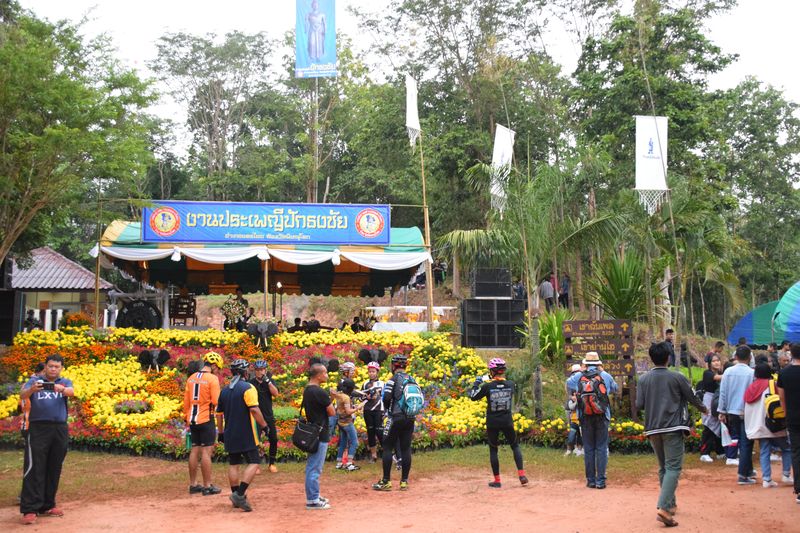
Today the tradition is observed on a grand scale, and has become a cultural tourism attraction drawing people from Mueang Nakhon Thai district and subdistricts, as well as outsiders. The celebration lasts 10 days and nights, from waxing 13th to waning 7th in the 12th month.
Day one. The activities were about the exhibitions from various state agencies, a merchandise caravan, a display of Mueang Bang Yang Museum miniature, a Nakhon Thai food air, a red-cross type fair, local cultural shows, music shows, concerts, booths selling local products (OTOP), and a contest of locally grown produce.
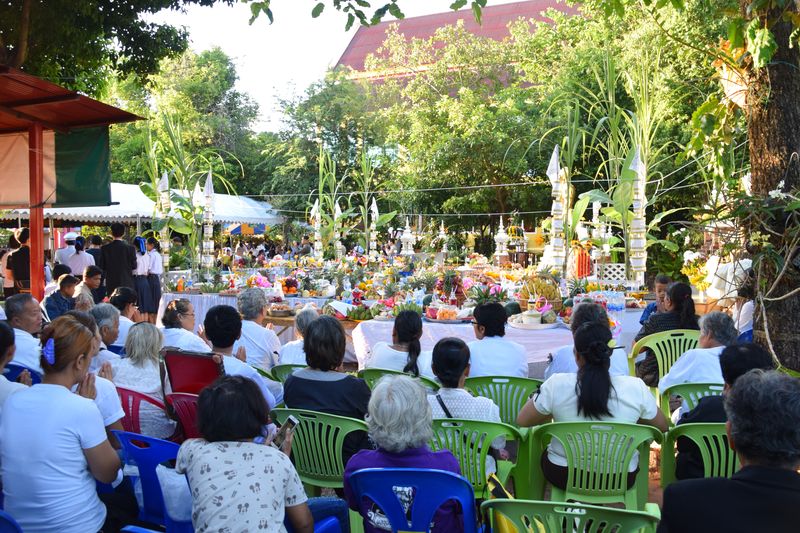
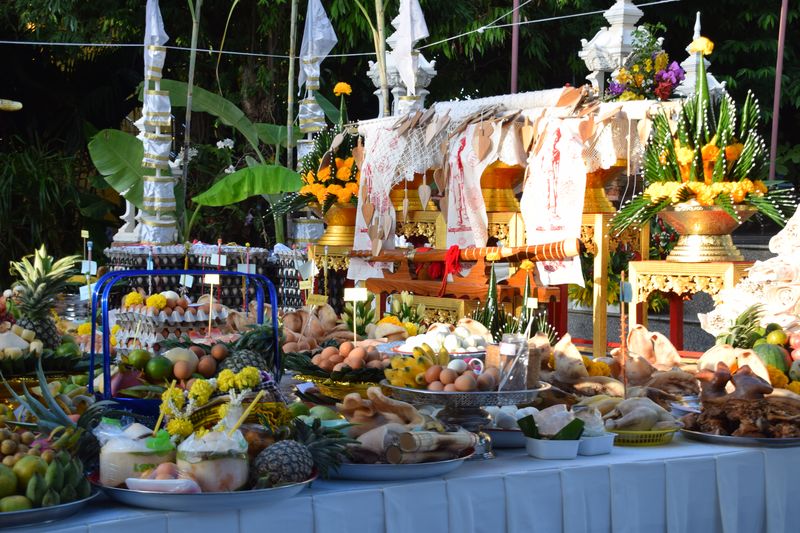
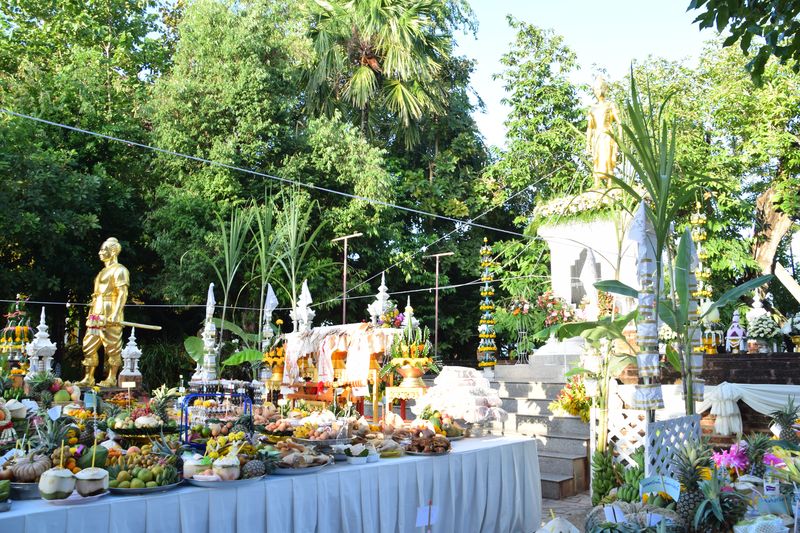
Day two. In the morning, government agency representatives joined local residents at Wat Klang to perform a worshipping rite in honor of Po Khun Bangk Klang Tao (Po Khun Si Inthrathit) at his monument. Phitsanulok Governor presided over the ceremony, which was a mixed Brahmin and Buddhist one.
In the afternoon, beautiful grand processions from all subdistricts paraded the streets in honor of the Po Khun and King Rama IX. Each procession boasted certain things that represented their identity. The processions headed to the Nakhon Thai District Office.
The nighttime activities featured a light-and-sound show which dramatized the histories of the Po Khun and the Pak Thong Chai tradition. The spectacular production was also meant to show off the potentiality of Nakhon Thai people. The show ended with impressive fireworks. More entertainment available was the beauty contest and the singing contest.
Day three. Participants gathered at Khao Chang Luang to attend the opening ceremony, followed by the hike up to the tops of Khao Chan Pane, Khao Yan Hai and Khao Chang Luang respectively. Generally the Phitsanulok governor would lead group. The ritual itself, however, would be quite different from what had been done in the past. In the evening the public fun was in the form of beauty contests.
Days four – ten. An exhibition done by the state agencies was there. More things included a flea market, a display of Nakhon Bang Yang Museum model, a Thai food festival, a red-cross fair, local cultural shows, music shows, concerts, OTOP booths, a contest of farm produce, sports contests, a kite-flying contest, and shows from students.
Thus the annual local merit-making activity of Nakhon Thai people has evolved into a big provincial fair, supported by the government and private sectors. They were responsible for both the financing and public relations work. Local folks themselves no longer have the important role as organizers, as before. They were just participants who went there to see things, watch the shows, buy the stuff being sold there, and to join the parades. Apparently they have lost trace of the true old tradition. One example of such change is about the flags. Each symbolic one in the past was over 2 meters long. They are now replaced with 6-meter ones, by the Nakhon Thai Subdistrict.
The recent 2016 fair marked a turn in going back to the old simple tradition, as in goneby days, because it was held during the time the nation was still in mourning for the late King Rama IX. The fair was held for only 2 days. In the morning of the waxing 14th of the 12th month they worshipped Po Khun Si Inthrathit at his monument in the Nong Pu public park and at Wat Klang. The next day, starting off early government officials, local folks, students, and monks journeyed up the mountains to plant all the three flags. Phitsanulok Governor Mr. Suphachai Iamsuwan presided over the rituals. That over, the groups dispersed and went home. There was no public entertainment of any kind.